AI Strategy
AI Is Not Becoming Electricity Yet, And It Is Not a Bubble Either
Executive Summary
Artificial Intelligence today sits between two polarised narratives. On one side, AI is described as the next electricity, destined to become invisible, ubiquitous infrastructure. On the other, it is dismissed as a bubble, overhyped, overfunded, and due for correction. Both views feel compelling, yet neither fully explains what individuals, enterprises, and institutions are actually experiencing.
This paper argues that the confusion is not about AI’s potential, but about how we interpret its evolution. Generative AI is not a single technological moment or a clean platform shift; it is a layered capability journey unfolding over time. From foundation models and conversational interfaces to agentic systems, multi-agent coordination, and autonomous intelligence, each layer matures on its own trajectory, with its own expectations, value creation patterns, and friction.
This layered evolution explains why excitement and disillusionment coexist, why individuals adapt quickly while enterprises hesitate, and why debates about ROI, readiness, and risk feel unresolved. Rather than asking whether AI is hype or reality, this paper reframes the question: how do we design systems, organisations, and mindsets that can absorb continuous advances in intelligence without becoming brittle?
Two Narratives. One Reality We’re Missing.
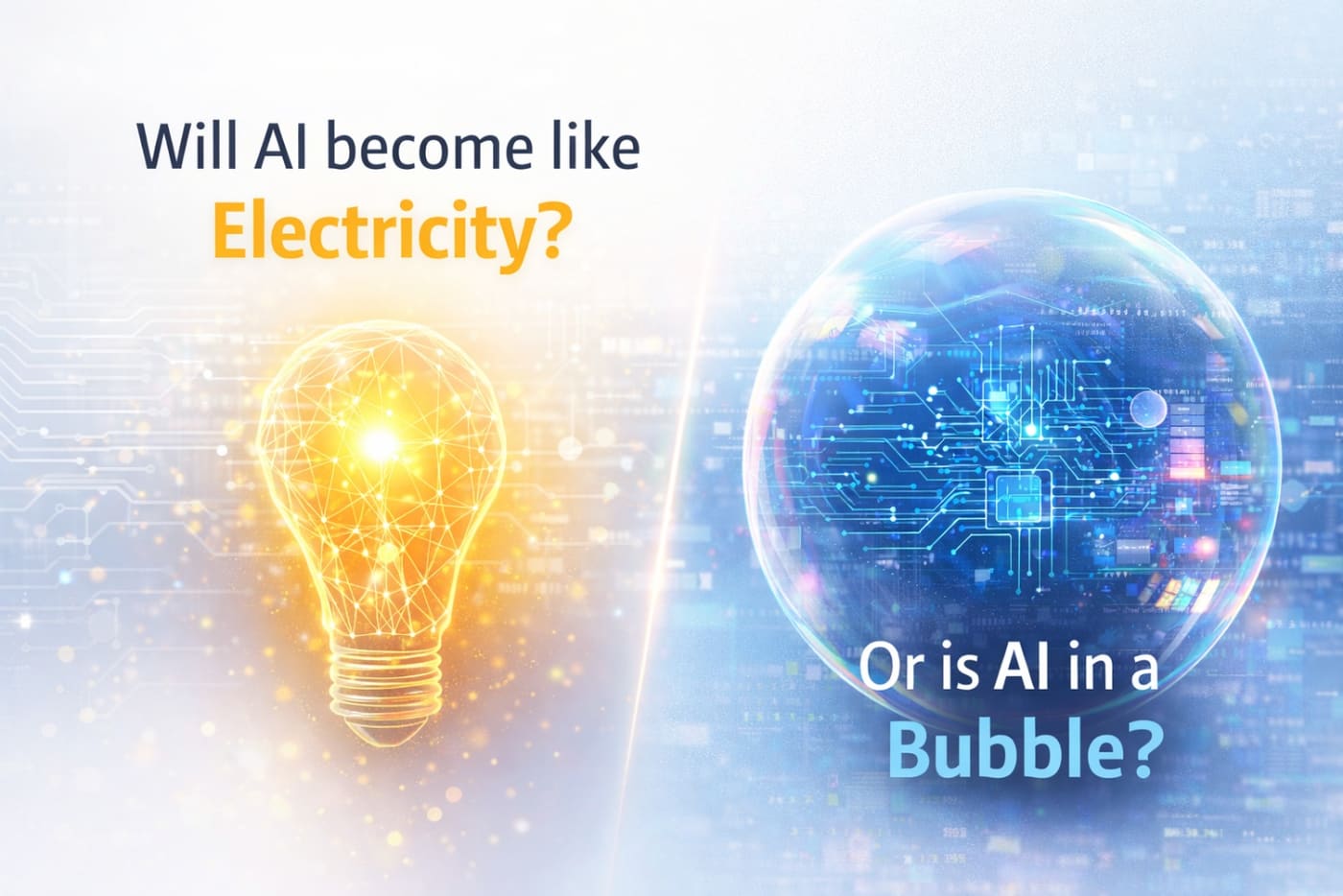
Two claims dominate today’s AI conversation.
The first says: AI will become like electricity. Invisible. Ubiquitous. Always on.
The second says: AI is in a bubble. Overpromised. Oversold. Due for a correction.
These views appear irreconcilable, yet both resonate. That alone should tell us something important.
They are not arguing about the same thing. They are describing different time horizons, different layers of capability, and different definitions of impact. The real mistake we keep making is treating AI as a moment, something that either “arrives” or “fails”, rather than as an evolutionary process.
Transformational Technologies Don’t Arrive. They Accumulate.
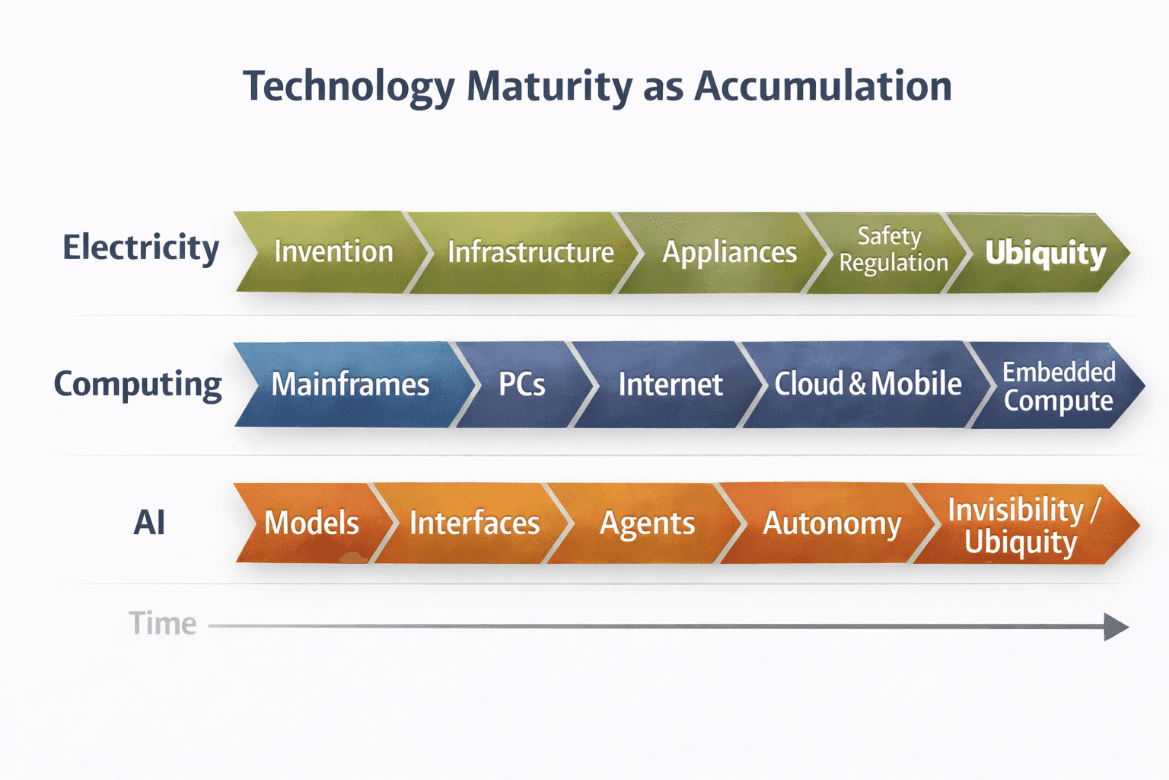
Electricity did not become electricity the moment generators were invented. It took decades of infrastructure build-out, safety standards, appliances, regulation, skills transformation, and societal trust before it disappeared into the background and became foundational.
Computing followed the same pattern, from mainframes to PCs, from the internet to cloud and mobile, and now into embedded intelligence. Each phase felt revolutionary. Each phase disappointed expectations. None of them were the end state.
AI fits this historical pattern, with one crucial difference: speed. Capability layers are emerging faster than our institutions, organisations, and mental models can comfortably absorb.
AI Evolves in Layers, Not on a Single Curve
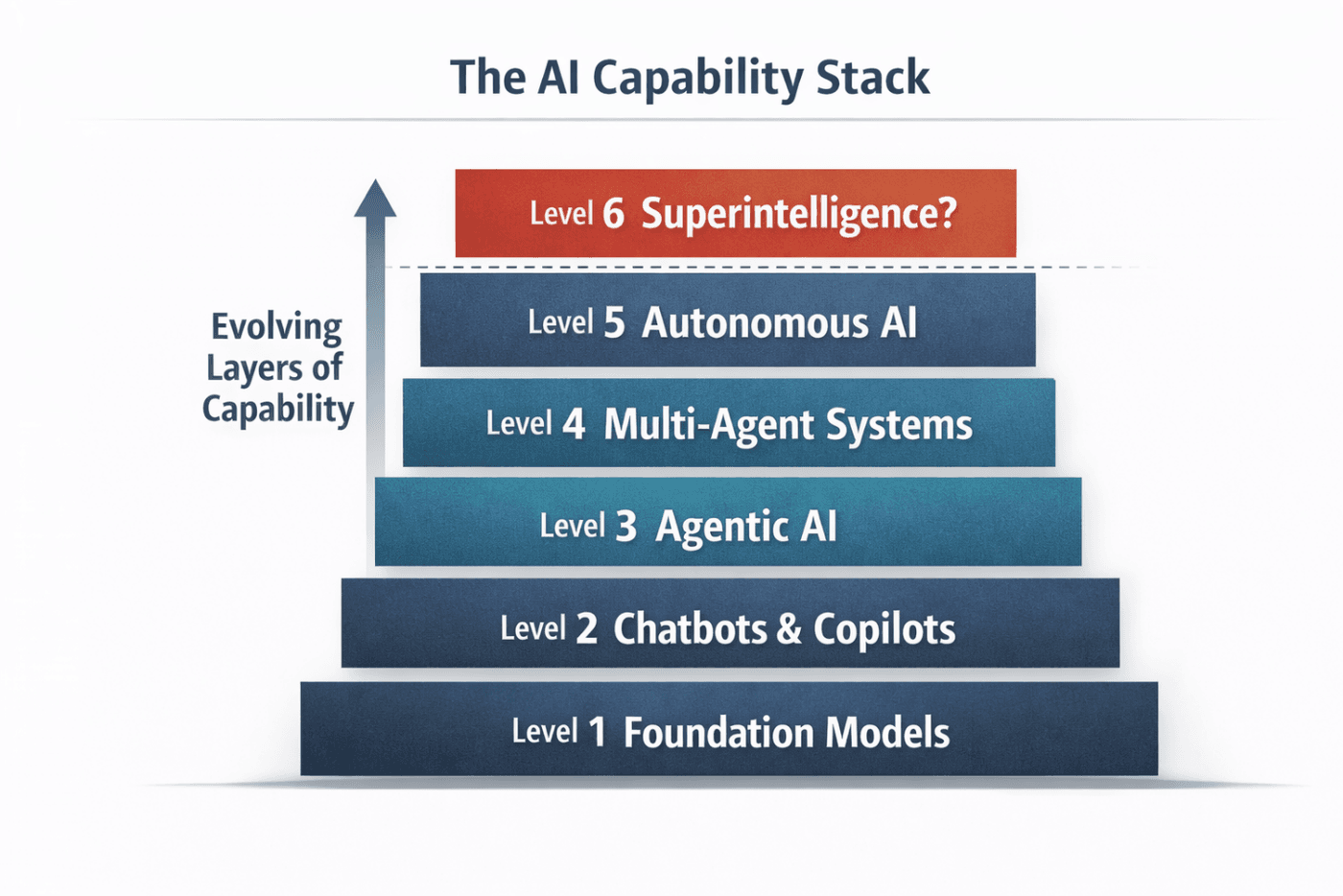
What we casually call “AI” today is not one thing. It is a stack of capabilities in motion.
We began with foundation models, systems capable of large-scale probabilistic reasoning. We then wrapped them in interfaces, chatbots and copilots, making them usable. We are now entering the era of agentic AI, systems that can reason, plan, and act using tools. Beyond this sit multi-agent systems, where coordination and orchestration matter more than raw intelligence. Then come autonomous systems, AI that adapts and optimises over time with minimal human direction.
There may well be a final horizon, superintelligence, but that is a theoretical boundary, not today’s adoption challenge.
The critical insight is this: each layer does not replace the previous one. It absorbs and reframes it. And each layer generates its own cycle of excitement, expectation, and disappointment. That is why AI can simultaneously feel transformational and unfinished.
Why the “Electricity” Analogy Feels Right, and Why It Misleads
The claim that AI will become like electricity is directionally correct, but temporally wrong. Electricity became powerful only once it became boring. AI is still fascinating, which tells us it is not yet infrastructure.
When leaders say “AI is the new electricity,” they are often describing where this ends up, not where we are. Confusing those two leads to unrealistic expectations, rushed investments, and inevitable backlash.
Why the “Bubble” Narrative Persists
At the same time, sceptics are reacting to something real. We see inflated expectations, fragile pilots, duplicated investments, and plenty of AI theatre. Many organisations have built impressive demonstrations that stubbornly refuse to scale.
Calling this a bubble assumes a single rise-and-fall story. What we are actually seeing is misaligned expectations attached to immature layers, while deeper layers continue to advance. Disillusionment in one layer often coincides with breakthroughs in another. That is not collapse, it is layered evolution.
Platform Shift or Industrial Revolution?
Is AI just another platform shift, like cloud or mobile? Or is it something closer to an industrial revolution?
The answer is: both. AI begins life behaving like a platform, tools, productivity gains, ROI cases. But it acts like an industrial revolution because it reshapes work, skills, organisational design, and decision-making, and never truly stabilises.
Platform shifts settle. Industrial revolutions compound. This duality explains much of today’s enterprise anxiety.
Individuals Learn Fast. Enterprises Pause, Rationally.
For individuals, AI adoption is a learning journey. You experiment, fail, and adapt. Switching costs are low and skills compound quickly.
Enterprises live in a different reality. They carry legacy systems, compliance requirements, architectural debt, workforce implications, and board-level accountability. Their hesitation is not ignorance, it is rational risk management.
Their real question is not “Should we adopt AI?” It is: how do we build today without locking ourselves into yesterday’s intelligence?
The Enterprise Paradox
This creates a painful tension. Move too slowly, and risk falling behind. Move too quickly, and risk anchoring on the wrong abstraction.
The result is familiar: pilots everywhere, impact nowhere. The issue is not ambition. It is where decisions are being anchored, on tools instead of foundations.
From AI Solutions to AI-Resilient Systems
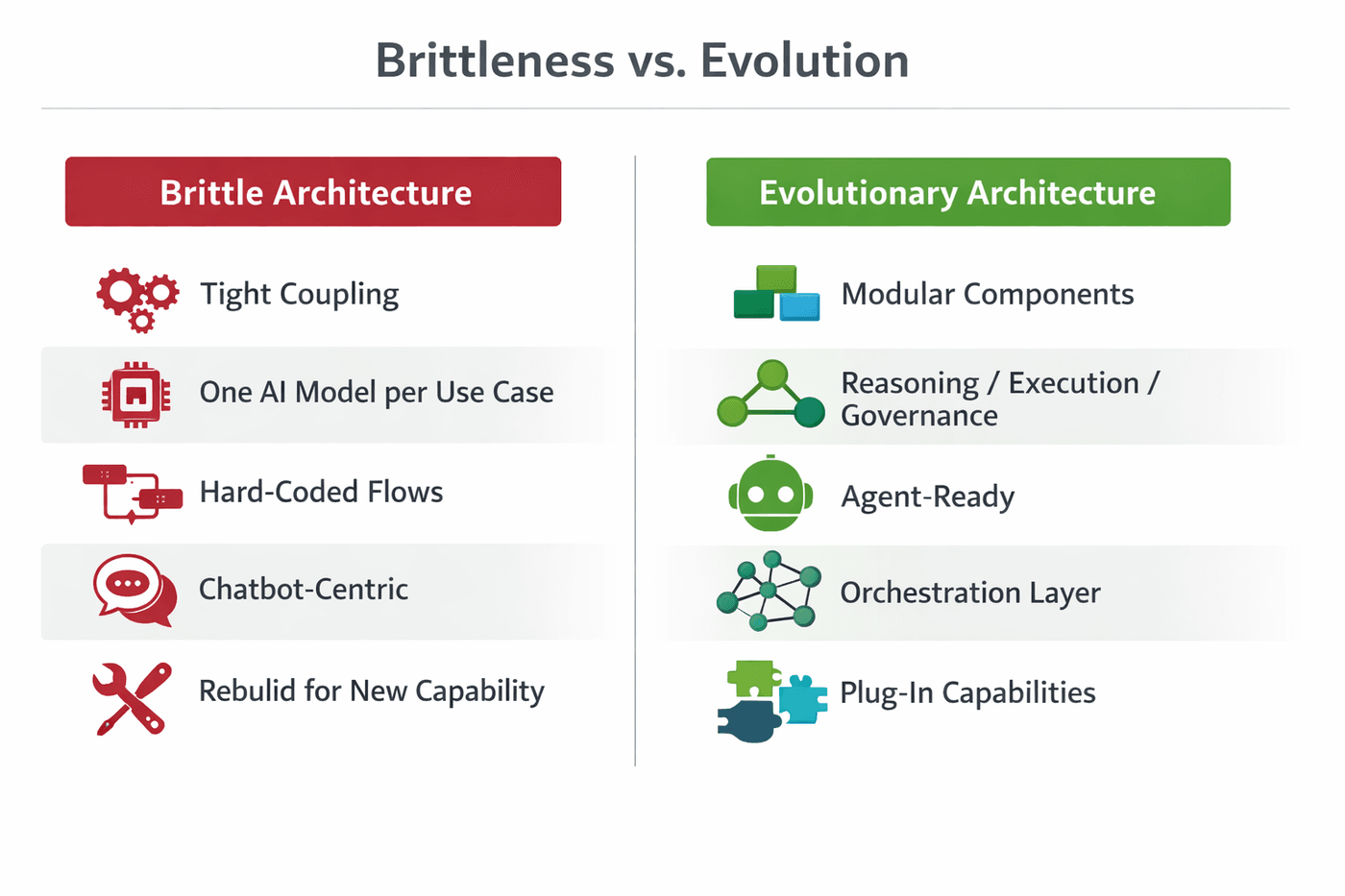
The more useful reframing is this: the question is not whether to build chatbots, agents, or autonomous systems.
The question is whether your technical and organisational architecture can survive multiple generations of AI capability.
That means prioritising modular, composable foundations; clear separation between reasoning, execution, and governance; and organisations designed to evolve continuously, not periodically. This is not scepticism. It is resilience.
ROI Is Not the Problem. Timing Is.
Early AI layers deliver productivity gains. Agentic layers unlock process transformation. Later layers will enable business model change.
Expecting late-stage returns from early-stage capabilities almost guarantees disappointment, and fuels the “AI doesn’t work” narrative. In reality, the mismatch is not between value and reality, but between expectation and maturity.
Technology Is Ready. Humans Are the Constraint.
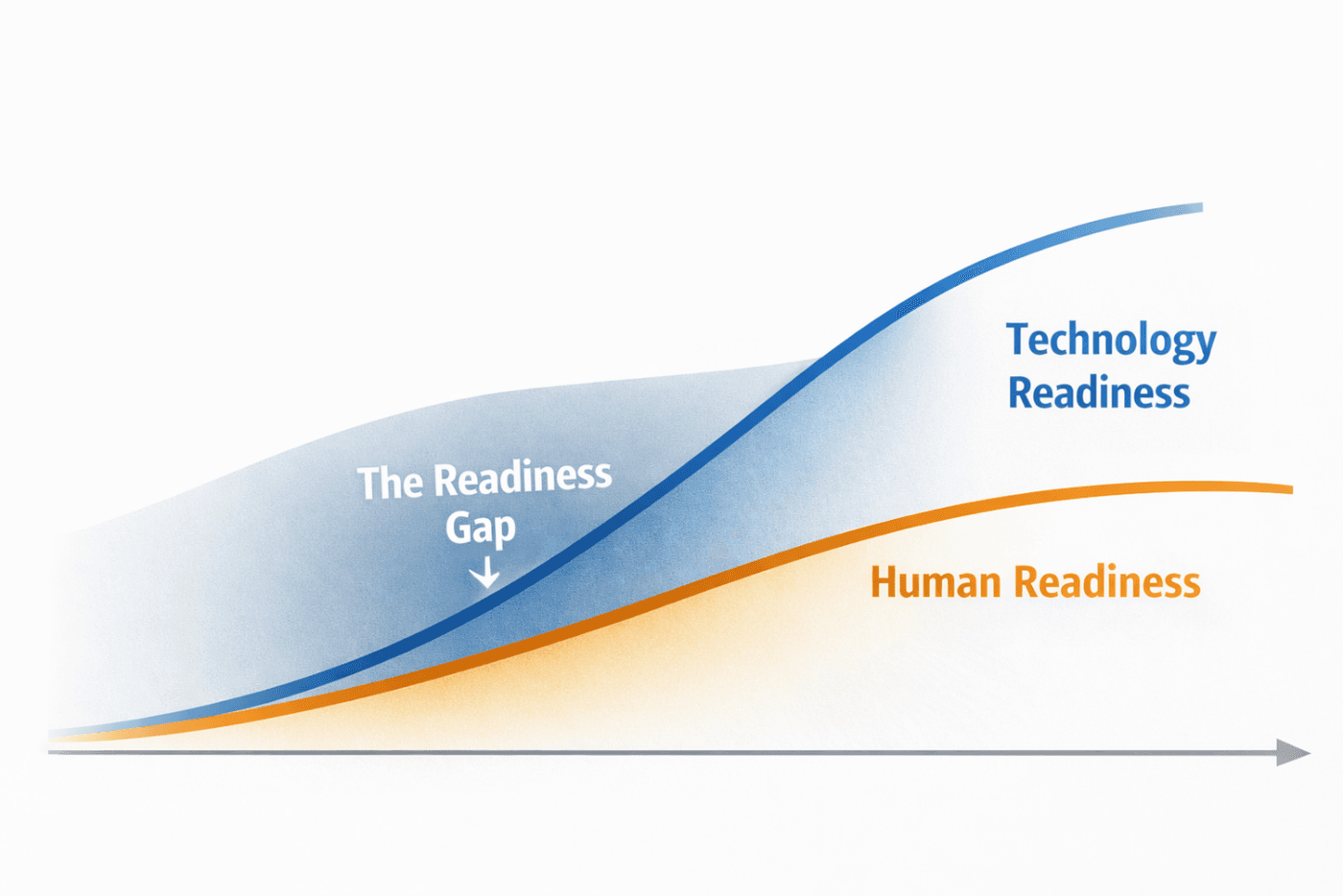
AI capability is advancing at extraordinary speed, new models, new breakthroughs, almost daily.
Human systems are not. Most enterprises were designed for stability. AI demands adaptability: fungible skills, new roles, new incentives, and comfort with perpetual change. The bottleneck today is no longer technology. It is human and organisational readiness.
So Where Are We, Really?
We are not at “AI as electricity.” We are between usability and early operationalisation, an uncomfortable but necessary phase where hype, fear, progress, and confusion coexist. This leads to a critical conclusion: we should expect many AI hype cycles, not one. Confusion is not failure, it is a signal that layered evolution is underway.
The real risk is not experimenting too early. It is building brittle systems, technical or organisational, that cannot evolve.
Better Questions for the Next Phase
Instead of asking:
- Is AI hype or reality?
- Should we act now or wait?
We might ask:
- Which AI capability layer am I actually engaging with?
- Am I building a solution, or an evolving system?
- Is my organisation designed to absorb continuous intelligence?
Because when AI finally becomes boring, when it fades quietly into the background, that is when it will have truly become powerful. Until then, debate is not noise. It is a necessity.
Published by Brain AI. BrainAI Systems Ltd builds the reasoning and governance layer that lets enterprises automate decisions they could not previously automate.